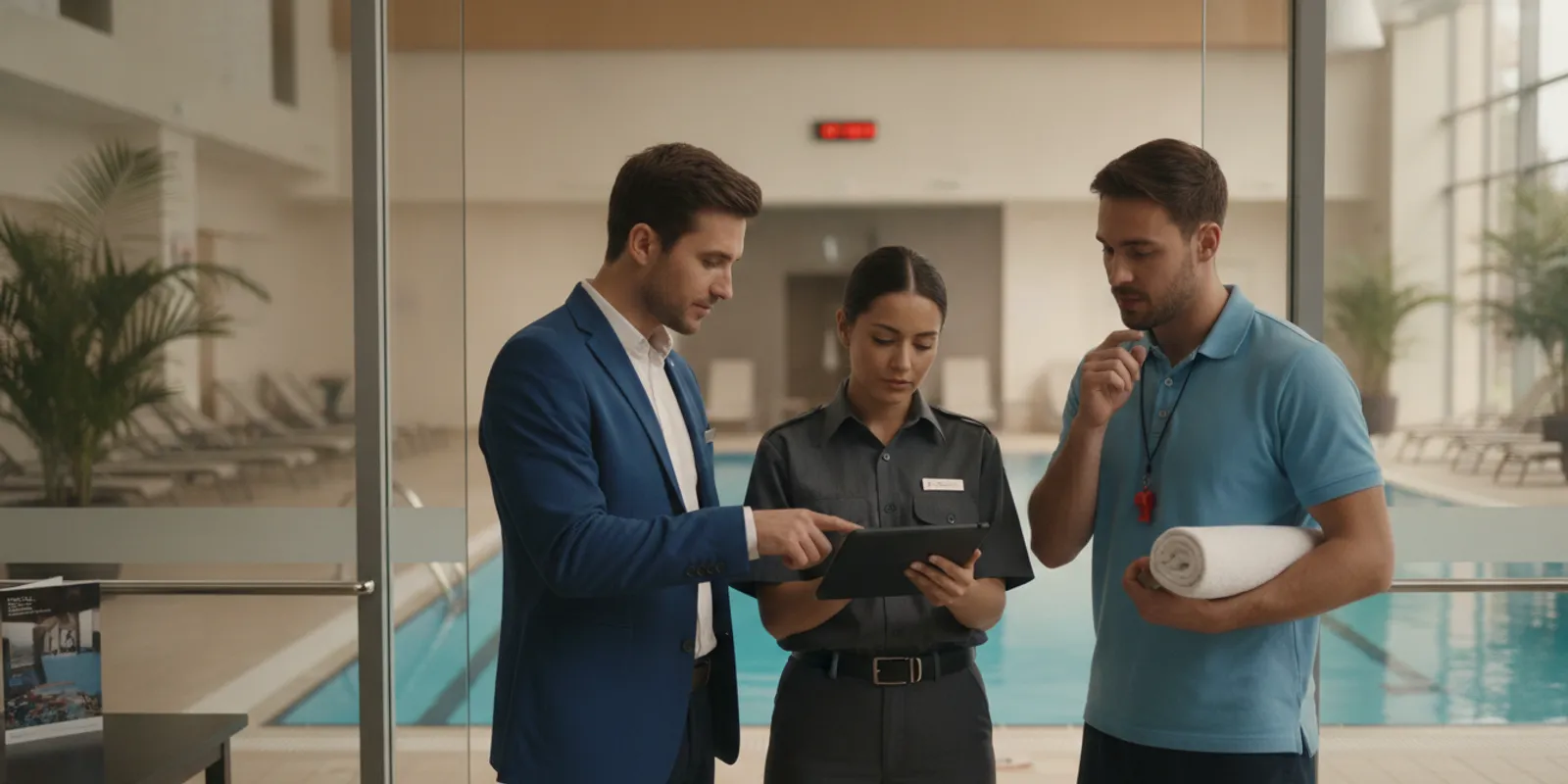
Hotel pool staff alert response planning should make one thing clear before an alert arrives: who acknowledges it, who goes to the pool, and who coordinates the rest of the response. Hotels may have front desk, security, and aquatic staff on different schedules, so the plan must work at every hour. Technology can provide another layer of protection and prompt action, but it does not replace lifeguards, active supervision, or the facility’s emergency action plan.
A reliable plan assigns a primary responder and backup for each operating period, defines how each person receives and acknowledges an alert, and gives the team a practiced route to assess and escalate an event. Staff should follow the property’s emergency procedures and training. An alert is a cue to act, not a diagnosis or an all-clear.
What should a hotel pool alert response plan cover?
The written plan should connect the notification to specific people and actions. It should identify who receives the alert, who responds at the pool, who supports the response from the hotel, and how the team escalates when the first person is unavailable. Build the procedure around the hotel’s real staffing and emergency action plan.
Start by mapping the steps from notification through handoff. State who is expected to acknowledge an alert, which trained employee proceeds to the aquatic area, who stays available to coordinate from the desk, and who contacts additional responders or emergency services when the site procedure calls for it. Include a named alternate for breaks, absences, and competing duties.
The plan also needs a clear confirmation method. A staff member should be able to say, by the property’s approved radio or phone process, that they have accepted the response task. If no one confirms, the next person should not have to guess whether another colleague is already on the way. Define that missed-acknowledgment step in writing and rehearse it.
Use the hotel’s emergency action plan and applicable local requirements as the authority for rescue, first aid, and emergency-service decisions. WAVE positions its technology as an additional layer of protection for supervised aquatic environments. It supports staff awareness; it does not replace attentive supervision, trained people, posted rules, or a functioning emergency plan. Review the facility’s established procedures before adding a technology-specific step.
- Alert recipient: the role expected to receive and acknowledge the notification.
- Pool responder: the trained person who proceeds to the water area and acts within their training.
- Coordinator: the person who manages communication, access, and requests for support from the hotel side.
- Backup: the assigned alternate who takes responsibility if the primary recipient is unavailable or does not acknowledge.
- Escalation: the conditions and method for bringing in additional trained responders or emergency services under site procedures.
Writing these roles down avoids broad instructions such as “notify staff,” which can leave each employee assuming someone else is responsible. The plan should distinguish a notification task from a rescue task. Employees should perform only duties they are trained and authorized to perform, and the designated aquatic responder should follow the hotel’s emergency action plan.
How should front desk, security, and aquatic staff divide responsibilities?
Assign roles by capability and location, not by convenience alone. Front desk staff can route alerts and summon help when those duties are part of their training. Security can support access and coordination. Aquatic responders follow their training at the water. A manager keeps the full response organized and ensures that follow-up is assigned.
A division of responsibilities is most useful when it matches the people who are actually on duty. A front desk employee may be well placed to receive an alert, contact the designated responder, and keep a communication line open. That does not automatically make the employee the person responsible for a water rescue. The procedure must respect training and authority.
Security staff may assist with reaching the pool, keeping the route clear, controlling access, or guiding arriving help, depending on their training and assignment. Pool attendants and lifeguards, where assigned, assess the situation and act according to their qualifications and the emergency action plan. The manager on duty can coordinate requests for additional hotel support and make sure required records and follow-up are handled after immediate response needs.
| Role | Initial action | Follow-through |
|---|---|---|
| Front desk or operations desk | Receive and acknowledge the alert; notify the designated responder. | Maintain communication and contact the backup or emergency services when the procedure requires it. |
| Security | Proceed or assist when assigned and trained; support access to the pool area. | Keep the response route clear and guide arriving assistance as assigned. |
| Pool attendant or lifeguard | Assess the situation and act within training and the facility emergency plan. | Coordinate care and handoff to emergency responders when appropriate. |
| Manager on duty | Confirm staffing and help coordinate escalation. | Ensure incident documentation and post-event review are assigned. |
These are planning functions, not a universal rescue protocol. Adapt them to the property, local rules, staff qualifications, and emergency action plan. When reviewing alert options, WAVE’s GUARDian system information and lifeguard alert equipment can help a hotel frame questions about how technology may complement existing staff procedures.
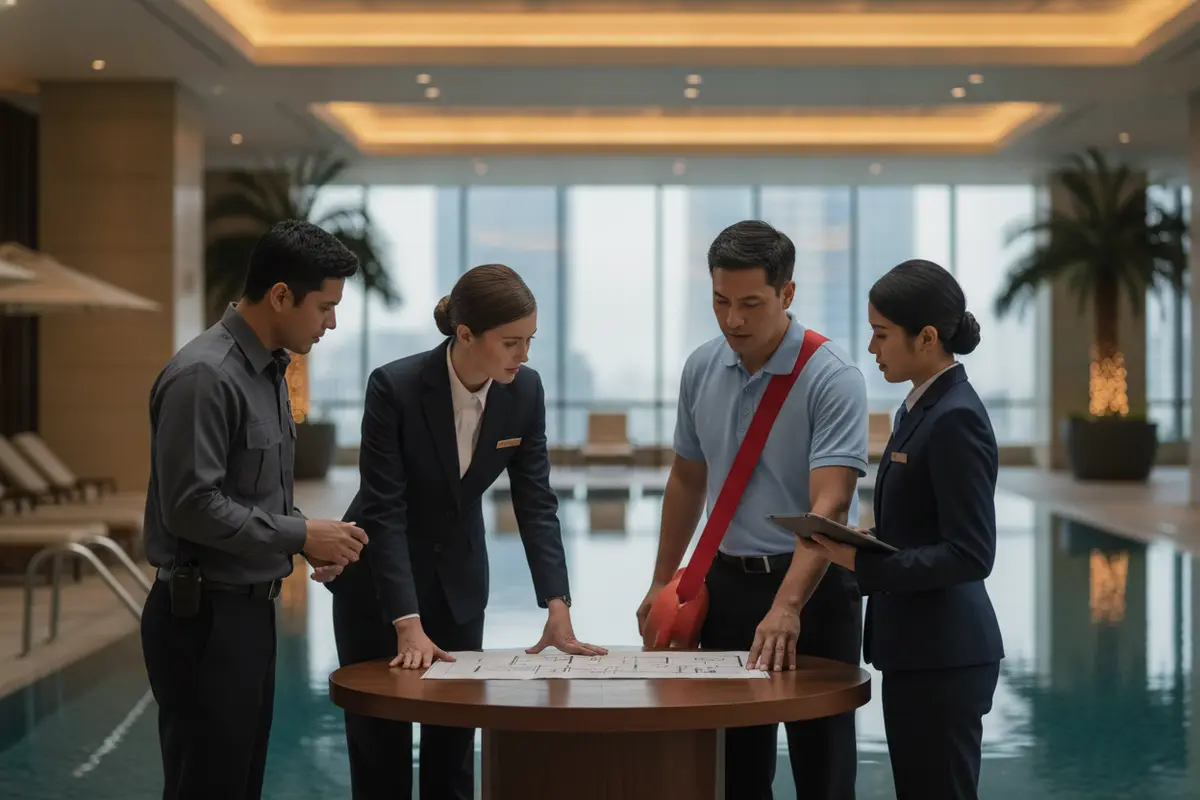
Make the responsibility specific to each shift. A named role on the roster is more useful than a general reference to “the staff member on duty.” Give the recipient a backup and a way to confirm that the task has transferred. When the shift changes, the incoming employee should know who currently holds responsibility and whether any alert or follow-up remains open.
How can hotels keep coverage dependable across shifts?
Build a coverage map for every operating period, including nights, weekends, breaks, and seasonal staffing changes. Each time block needs a primary recipient, a backup, a reliable way to reach both, and a defined handoff. Walk and test the alert route in the actual facility rather than relying on the organization chart.
A response plan can look complete on paper and still fail at a shift boundary. One employee may leave before a replacement arrives; the night shift may have fewer people; or the assigned recipient may be busy with a guest issue when an alert comes in. Identify those conditions in advance and decide who assumes the task.
Prepare a simple coverage matrix. List the pool’s operating periods down one side and the assigned primary, backup, communication method, and escalation contact across the other. Include any period when the pool remains accessible but the usual daytime team is not present. Keep the matrix current when schedules, pool hours, or staffing arrangements change.
- List the hours when guests can use the aquatic area and the staff roles present in each time block.
- Assign a primary alert recipient and a backup for every block, including breaks and overnight periods.
- Specify how the alert is acknowledged and what the backup does if acknowledgment does not arrive.
- Identify who contacts aquatic responders, management, and emergency services under the approved plan.
- Walk the route from the likely alert recipient’s location to the pool and check access, communication, and potential obstacles.
- Test the sequence during a safe drill, record gaps, and assign someone to correct each one.
Consider where the assigned person is likely to be during each shift. Can a radio or phone be used in the relevant work areas? Are there doors that require a key or access code? Does guest activity near the pool entrance affect movement? These checks are specific to the property, so a tabletop review should be followed by a walk-through where appropriate.
At shift change, use a direct handoff rather than assuming that the schedule communicates everything. The outgoing employee should identify the incoming primary and backup, explain any unresolved system notification or event follow-up, and confirm that the incoming team knows the current procedure. Keep the procedure accessible at staff stations and include it in onboarding. A document that employees cannot find during a busy shift is not operationally useful.
Hotels considering how alerts fit into an overall plan can review WAVE’s frequently asked questions and its overview of how the system works. Use product information to shape questions, then confirm the proposed configuration and staff process for the property rather than assuming every site uses the same alert route.
Which alert details should operators evaluate?
Evaluate the complete path from detection to a staff member’s action. Ask who receives a notification, how it is acknowledged, how a missed notification is handled, and how the aquatic responder communicates with the desk. A product feature matters only when it fits the hotel’s staffing, operating conditions, and written response process.
Before selecting or expanding an alert system, define what staff need to know and how they will use that information. An alert sent only to an unattended desk may not reach the pool team in a useful way. Ask how notifications reach assigned responders, what types of events create an alert, and what happens if a staff member misses or cannot acknowledge it.
WAVE describes wearable sensors that detect prolonged submersion or lifeguard water entry, with alerts delivered to staff through vibrating bracelets and facility alerts. Its wearable, wireless approach is intended to act as a force multiplier for supervised aquatic operations. The specific alert path and deployment should be confirmed for the hotel’s proposed setup. Do not treat an alert as a determination of what has happened or as an all-clear.
Map the alert path in a few plain steps: event detected, notification received, recipient acknowledges, responder moves to assess, and coordinator supports escalation under the emergency action plan. For every step, identify the responsible person and the communication method. If a step depends on someone being in one particular room, account for what happens when that person is away.
Evaluate how the system will be used under the hotel’s real conditions, including pool layout, staffing patterns, guest activity, and communication coverage. Ask what training and deployment assistance are available, how staff learn their alert responsibilities, and how the team will check readiness over time. WAVE’s swimmer wearable information may help facilities understand the swimmer-side equipment being considered, while its product overview provides a wider view of available equipment.
Technology should fit within a layered plan. Do not let the presence of a notification reduce active supervision or weaken staff readiness. Confirm that each employee knows what they are expected to do when they receive an alert, and ensure the procedure addresses uncertainty, missed acknowledgments, and escalation without relying on assumptions about the device.
For inspection context, the CDC’s Model Aquatic Health Code cross-reference guide is described as a resource for aquatic venue inspectors and inspection-form development. It can inform a facility’s review process, but hotel operators should use applicable local requirements and qualified professional guidance to determine what applies to their property.
What should hotel staff practice before an alert happens?
Practice the communication and handoff, not just the written plan. A tabletop exercise can expose confusion about who responds, while a safe walk-through can reveal route or communication issues. Record each gap, assign an owner, and verify that the correction works in a later practice.
Practice turns role descriptions into actions employees can recall under pressure. Start with a short discussion-based exercise: the facilitator presents a test alert, and each participant explains what they would do first, whom they would contact, and how they would confirm the next person has accepted responsibility.
A later walk-through can reveal details the discussion misses. Staff can follow the approved route, test the designated communication method, and demonstrate how the backup takes over if the primary recipient is unavailable. Follow the hotel’s rules for drills and never create an actual emergency or place a guest at risk. Keep any system test within the manufacturer’s and facility’s approved process.
- Can the assigned recipient explain their first action without prompting?
- Does the backup know what condition requires them to take over?
- Can the desk and pool responder communicate from their normal work locations?
- Do employees know how to follow the emergency action plan and summon appropriate help?
- Can staff identify an access obstacle or communication gap along the response route?
- Is someone assigned to record the exercise and close out any corrective actions?
Use a short scenario to test a particular weakness rather than trying to test every possible event at once. For example, a hotel could rehearse an alert received while the normal desk contact is assisting a guest. The backup should then demonstrate the agreed acknowledgment, notify the assigned responder, and maintain the required communication. This tests role transfer without asking staff to improvise a rescue procedure.
After practice, record the date, participating roles, the scenario tested, what worked, what did not, and who owns each correction. A finding such as “communication unclear” is too broad to fix. Write the specific issue, such as “night manager did not know which extension to call,” then update the procedure or training and test the revised step.
Review the plan when pool hours, staffing, access, communication tools, or alert configuration changes. Include new employees in orientation and refresh the process for returning seasonal employees as needed. WAVE’s aquatic emergency action plan guide offers a related planning resource, and its lifeguard water-entry detection guide can help frame questions about staff alerts.
How should hotels document and improve the response?
Documentation should help the hotel learn whether the plan worked, not distract from immediate care. Follow policy and applicable law for real-event records. After an event or drill, review the timeline and handoffs, identify a process correction, assign an owner, and check that the change has been completed.
For a real event, staff should follow the hotel’s incident-reporting process and applicable legal requirements. Preserve relevant system information according to organizational procedures, and do not allow paperwork to delay immediate care or emergency escalation. Limit records and access in line with the hotel’s privacy and information-handling rules.
After the immediate response, review the sequence: when the notification arrived, when it was acknowledged, who moved to the pool, whether the backup was available, and how communication worked. Note the actions that helped as well as delays or gaps. Review the process as a system rather than assuming that an individual caused a problem; unclear assignments, staffing conflicts, and access barriers can all affect a response.
Turn each finding into a practical change. The correction might be a clearer roster, a revised handoff, a different place to keep the procedure, or a repeat drill for a particular role. Assign one owner and a due date under hotel policy. Then verify the change in a later exercise or plan review. Keeping the date and result makes it easier for a manager to see whether the change was actually completed.
When comparing alert options, consider the operational work needed to keep staff ready, not only equipment features. WAVE provides deployment assistance and team training; ask what applies to the proposed configuration and what the hotel’s own team will maintain. For current plan information, consult the WAVE pricing page and confirm the details relevant to the property directly. Do not assume that a particular quantity, service, or configuration is included unless it is confirmed for the proposed plan.
A manager can make the review routine by adding a few questions to an existing safety meeting: Has shift coverage changed? Have contact methods or pool access changed? Are any corrective actions still open? Has every employee assigned a response task received the relevant instruction? This brief review helps keep the response plan aligned with operations instead of leaving it unchanged in a binder.
Frequently Asked Questions
Hotel alert procedures should be specific to the property, aligned with local requirements, and practiced by the employees assigned to use them. The answers below address common planning questions, but they do not replace the hotel’s emergency action plan, staff training, or professional guidance.
Does an alert system replace a hotel lifeguard?
No. Alert technology can add a layer of protection and support staff awareness, but it does not replace attentive supervision, trained responders, or the hotel’s emergency action plan. Hotels should determine supervision and staffing requirements under applicable rules and qualified professional guidance.
Should front desk employees respond to the pool?
The plan should assign front desk employees only duties they are trained and authorized to perform. They may receive and route a notification or summon help if that is part of the procedure. Aquatic response and rescue actions belong to appropriately trained personnel acting under the facility’s emergency plan.
What should happen if nobody acknowledges an alert?
The written procedure should define a backup route, such as notifying another designated role or the manager on duty, and explain when the next escalation step applies. Practice the missed-acknowledgment scenario so staff do not have to invent a response in the moment.
How often should a hotel rehearse its alert process?
Set a schedule consistent with hotel policy, applicable requirements, staff turnover, and system changes. Practice again when staffing, communication methods, pool access, or alert configuration changes. Record the gaps identified and confirm that corrective actions have been completed.
Can hotel staff use an alert process when no dedicated lifeguard is assigned?
An alert may notify designated hotel staff so they can follow the property’s response procedures, but it does not provide lifeguard supervision or guarantee a rescue. Before relying on any alert process, the hotel should assess staffing, applicable requirements, and its ability to respond safely.
Make the response plan usable on every shift
A hotel response plan is useful when assigned employees can explain their role, contact the right backup, and follow the facility’s emergency procedures without guessing. Keep the roster current, practice the handoffs, and assess alert technology as one component of a broader aquatic-safety plan.
Hotel pool staff alert response planning works best when the roles, backup route, and escalation steps reflect the actual property and are rehearsed by the people who will use them. Review coverage regularly, keep trained human supervision and emergency procedures central, and make every improvement traceable to a named owner. A clear, practiced process gives staff a more dependable basis for responding when a notification arrives.
